
 By
By
With the arrival of autumn, the holiday season comes to an end for most people. For many, and especially for vulnerable groups, it also brings relief after a summer of heat that once again broke records. The extreme temperatures also had a considerable impact on the energy sector and its markets. Alongside the simmering conflict between Iran and the United States, whose diplomatic ups and downs are becoming increasingly wearisome, it is therefore once again weather conditions that are determining prices in recent and coming months.
Historic heat
It is widely known that Europe was characterised by exceptionally high temperatures over long stretches of this summer. Since June, temperatures in Germany have been two to four degrees above the long-term average. Whereas European electricity demand in recent summers remained consistently at the lower end of, or well below, the pre-crisis level of 2018–2022, in June and July of this year it again came close to that benchmark for the first time. The main driver was the markedly higher cooling demand in the Central European countries. As a result, the temperature sensitivity of electricity demand in these regions is gradually approaching the level that has been observed in Southern Europe for years.
High temperatures go hand in hand with strong solar irradiation. According to the German Solar Association (BSW-Solar), solar power generation on 27 September 2026 had already exceeded the entire volume of 2025, at 90.2 TWh. The high number of sunshine hours and continuous PV expansion are decisive factors behind this record. In 2025, installed solar capacity stood at 107.8 GW, according to data from Fraunhofer ISE. PV thus accounted for around 19% of net electricity generation last year, according to the BSW. In August 2026, installed solar capacity is said to have grown to 128 GW, and by 2030 the German Renewable Energy Sources Act (EEG) provides for a total of 215 GW. PV will therefore continue to occupy the energy sector and confront it with challenges that must be met with flexibility – more on this below.
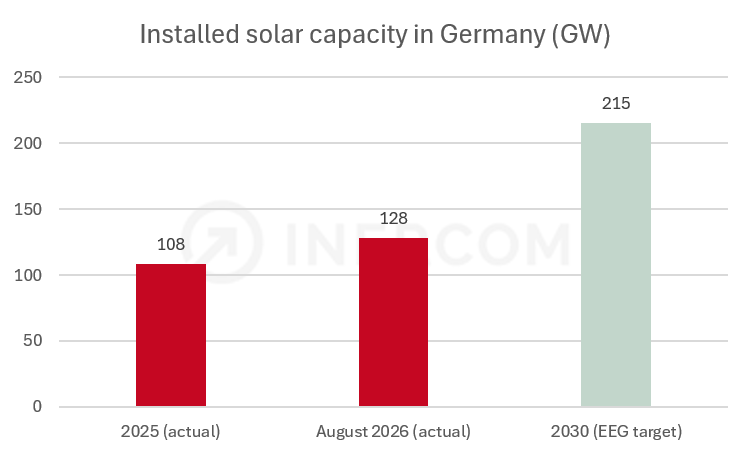
Source: Fraunhofer ISE (2025), BSW-Solar (August 2026), German Renewable Energy Sources Act (target 2030)
Historic drought
The second defining factor of this summer was the pronounced dryness. In the Nordic countries, available hydropower deteriorated markedly as early as the first quarter. In the following months, run-of-river generation in the Alpine region fell to its lowest level in the past ten years. The effects also extended to the French nuclear fleet. Together with high river temperatures, the situation at its peak led to an outage of around 12 GW of French nuclear capacity.
High spot prices were a direct consequence of this tight supply situation. At a day-ahead price of around 154 EUR/MWh, the last week of September was the second most expensive week of 2026 in Germany. By comparison, the average spot price over the same period was around 176 EUR/MWh in Austria, around 148 EUR/MWh in France and just under 192 EUR/MWh in Romania. Across Europe, spot price levels are therefore very high, but volatile in their intraday structure. Extreme spot prices usually occur only very briefly – namely in the midday and evening hours. The hours affected are mostly hours 19 to 21, when electricity demand is still high, partly because of cooling, while PV generation has already declined sharply or ceased altogether. By contrast, prices fall to a low during the day, which can even turn negative.
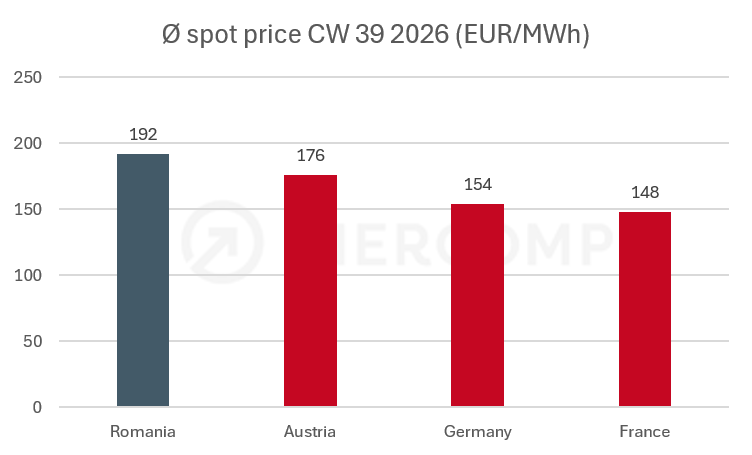
Average spot prices for CW 39 2026: day-ahead price
While such scarcity prices are still a fairly rare phenomenon in Austria and Germany, Eastern Europe already has more experience with them. As early as summer 2024, Romania experienced price spikes almost daily in July, August and September. In total, the spot price exceeded 400 EUR/MWh in 85 hours, although the gas price at that time was far lower than in the current year. Water flows on the Danube were also significantly better – hydropower generation in Romania in 2024 was 50% higher than in 2026.
Romanian answers and German questions
What is the situation in the current year, 2026? It would be natural to assume that, owing to water shortages and extreme heat, Romania is experiencing scarcity prices even more frequently and at even more extreme levels. In fact, however, the opposite is the case: whereas there were 85 hours with such prices in summer 2024, there have been only 13 hours this year. How can this finding be explained?
One answer lies in the expansion of battery storage. On the one hand, Romania has worked consistently on regulatory simplification for these installations, for example through exemption from grid fees. On the other hand, the price spikes have created an attractive business case for storage. According to the grid operator Transelectrica, around 1,100 MW of battery storage with a storage capacity of around 2,300 MWh was installed as of 1 September 2026. 300 MWh alone were built in August. By comparison, the Cernavoda nuclear power plant likewise has an output of around 1,300 MW. When all battery storage systems discharge in the evening hours, they have almost the same output as the existing nuclear power plant.
In the discussion currently under way in Austria and Germany on regulatory simplification and the exemption of battery storage, the need for such measures is mostly considered only with regard to negative prices. However, battery storage can not only absorb surpluses but also provide output in critical hours and thereby dampen price spikes. Storage is thus not only a tool for sunny middays with too much electricity; it can equally become a buffer for the hours in which supply and demand diverge most widely. To illustrate this, one final comparison: while the average spot price in Romania in September was around 31 EUR/MWh above the German level, the price in the most expensive hours was around 50–100 EUR/MWh lower than in Germany. Storage smooths the volatile daily structure, but it cannot change the entire mechanism of supply and demand.
What will winter bring?
Reports of a strong El Niño are moving to the centre of coverage for the coming winter. Although Europe should be affected less strongly by this effect, two scenarios are emerging: for the first part of winter, until December, temperatures above the norm are expected, while cold spells become more likely in January and February. At the same time, increasing precipitation in the first half of winter could bring some relief to water levels, particularly in western Europe. The World Meteorological Organization expects the El Niño event to last until February 2027.
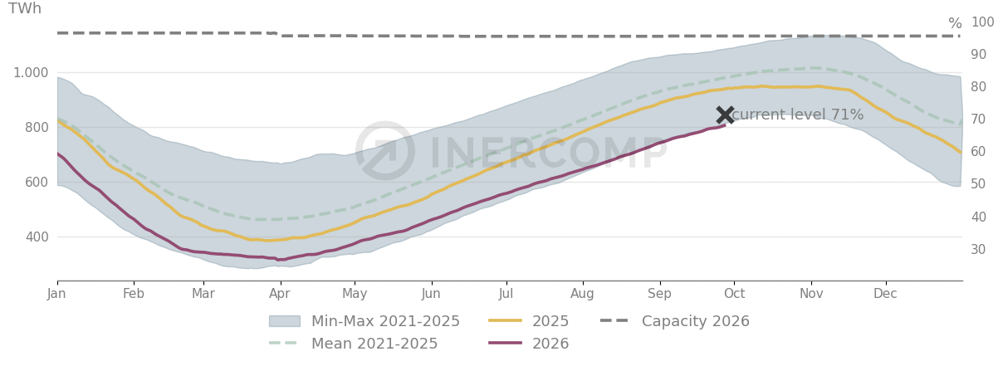
The starting position remains tense for the gas market. On 27 September, EU storage was 70.9% full – 11.3 percentage points below the previous year and below the minimum of the five-year range of 73.8%. European LNG imports recovered in September to around 3.7 TWh per day and largely offset the lower Norwegian flows caused by maintenance. In addition, the mild weather – around 3.1 °C above the norm is expected for Germany this week – the end of Norwegian maintenance work and the resulting higher availability for injection are providing support. It is likely to turn cooler at the start of October, however. We expect volatile prices at a high level.
The summer has shown how quickly heat, drought and demand, together with solar surpluses and subsequently disappearing PV generation, can trigger extreme price movements. The view to Romania shows that such swings do not necessarily have to be accepted. Where storage or flexible demand steps in at the right time, a bottleneck becomes a controllable system. Autumn brings not only falling temperatures but also a central question about the future for the energy sector: how can the growing volume of renewable energy be made so flexible that it is also available during a Dunkelflaute (a prolonged period of low wind and solar output)? Viable answers are needed promptly, because next summer is approaching, and the climate crisis, with its extreme weather events, is exerting an ever stronger influence on the energy sector as well.
Best regards,
Matthias Kisslinger
For the Inercomp team