
Conclusion
You cannot know the future. But you can use known market expectations.
Anyone who values historical profile costs relative to the forward curve avoids an error that can quickly become expensive when using absolute extrapolation.
and the mistake in valuing them
16.06.2026 • by Manuel Wissiak, Energy Expert at Inercomp • 7 min read
273,16 €/MWh.
That is the number you know from this year. Black on white, based on real data. Calculated from your customer’s load profile: profile value plus balancing energy costs, methodically sound, historically proven.
Now an offer needs to go out. Three-year term. And the question is: what do you use as the basis?
Nobody knows the future. Energy may become more expensive, or cheaper. Both are possible, both have happened. You cannot calculate the risk away. You do not have a crystal ball. What you do have is a number that is correct. Surely better than gut feeling. At least it is a reasonable starting point for the next years.
So: 273,16 €/MWh for 2023, 2024 and 2025.
Any other assumption would be speculation. Some number has to go into the offer. And how different can it really get?
Very different.
But one step at a time. To make sense of the numbers, we first need the context.
The profile
You are valuing a potential customer’s metering point: quarter-hourly load-profile data with both consumption and feed-in, covering the full calendar year 2022.
A first analysis of the average daily load curve shows a typical pattern: the customer reduces consumption during cheap midday hours. This means they buy disproportionately in expensive hours. That has a direct impact on the profile value.
Result: 268,20 €/MWh, compared with an average spot price of 261,40 €/MWh over the same period.
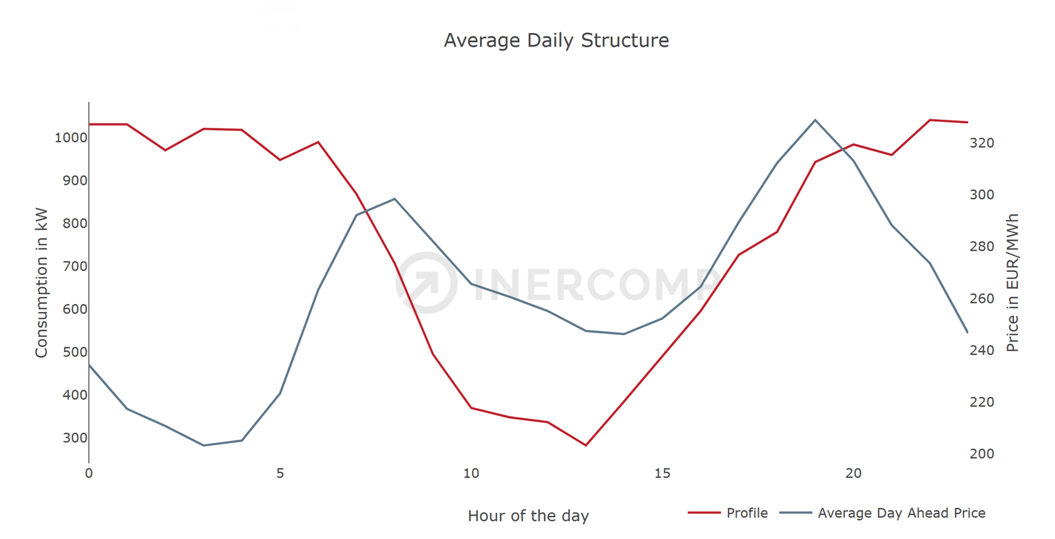
Chart 1: The profile reduces consumption during cheap midday hours and is more heavily weighted in expensive hours. As a result, the profile value is above the average price.
Balancing energy
When the actual load curve deviates from the forecast you submitted to the grid operator, the difference volumes are bought or sold at the balancing energy price. These deviation costs belong in every offer.
To quantify them historically, you need a forecast. The standard method: the previous-week method. The load for a given hour is forecast using the load from the same hour in the previous week. Simple, widely used, transparent, and acceptable as a baseline.
For 2022, this results in balancing energy costs of 4,95 €/MWh.
Your offer price as of 31.12.2022 for the delivery years 2023 to 2025:
I Profile value + balancing energy costs = 268,20 + 4,95 = 273,16 €/MWh
At first glance, that looks clean. But the problem is not yet visible.
What actually happened
The years 2023 to 2025 looked very different from 2022. Spot prices fell sharply, and with them all cost components that depend on the price level.
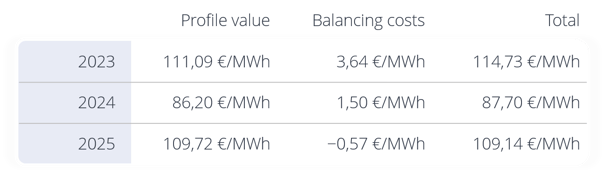
Table 1: Realised spot prices and balancing energy costs 2023–2025, example load profile.
Your offer: 273,16 €/MWh, identical for all three years.
The actual costs: between 87 and 115 €/MWh.
Of course, nobody could have known these actual costs on 31.12.2022. That is why the table is not a criticism of the forecast. It simply shows how far absolute extrapolation can miss the mark. The real point comes in the next step: at the time of calculation, better information was already available than the previous year’s value.
The information you had
On 30.12.2022, calendar futures closed on the exchange as follows:
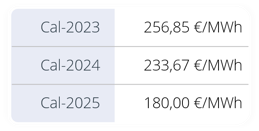
Table 2: Calendar future closing prices, 30.12.2022.
The market had priced in a clear price decline. Not to the extent that later materialised, nobody could know that. But the direction and tendency were clearly visible in the forward curve.
A method that ignores this and instead carries 273,16 €/MWh from 2022 flat into the future does not use the best available data. It uses the most convenient data.
The mistake: absolute extrapolation
Profile value and balancing energy costs are not fixed euro amounts. They depend on the absolute price level of the market. When the price level falls, profile value and balancing energy costs also change. They are not fixed euro blocks that remain the same regardless of market price.
Anyone who simply carries 273,16 €/MWh forward from a high-price year acts as if these costs were independent of the market price. They are not. In a falling market, the offer becomes systematically too expensive. In a rising market, systematically too cheap.
The better method: relative extrapolation
The key: do not express the costs in euros, but as a percentage of the spot price.

Profile value and balancing energy costs 2022, expressed as a percentage of the average spot price of 261,40 €/MWh.
This 104,50% describes something stable: the structural characteristics of the profile. Its shape, its deviation behaviour, its relative cost weight compared with the market. That does not change from year to year. What does change is the absolute price level and the forward curve provides that.
Apply 104,50% to the calendar futures that were already known on 30.12.2022:
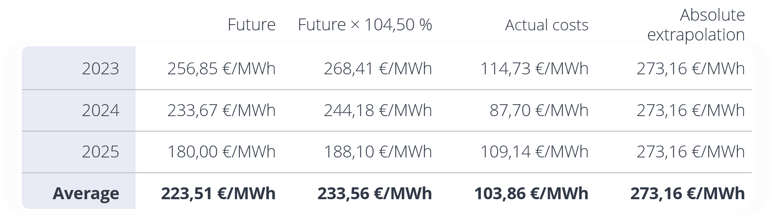
Comparison: relative extrapolation vs. naive absolute extrapolation vs. actually realised costs.
The relative offer is, on average, 39,60 €/MWh more competitive than the naive one. That corresponds to a 14,50% lower price position. For the same profile. Using market data that was already available on 30.12.2022.
What this means in practice
EinAn offer that is 14,5% above the market-based price loses tenders without you knowing why. An offer that is 14,5% below it destroys margin without you noticing it at the time of conclusion.
Relative extrapolation does not eliminate every forecasting error. Nobody knew on 31.12.2022 that the spot price in 2024 would fall to 86 €/MWh. But it eliminates an entire category of avoidable errors: those that arise when market expectations are ignored, even though they are already priced in.
You cannot know the future. But you can use known market expectations.
Anyone who values historical profile costs relative to the forward curve avoids an error that can quickly become expensive when using absolute extrapolation.

By Manuel Wissiak, Energy Expert at Inercomp • 16.06.2026
This article is based on analyses developed for the Inercomp Load Profiles eTool.
The figures used come from historical market data from 2022 to 2025 and serve as a methodological illustration.
More market analyses