Skip to content

EU Gas Storage

Why winter 2026/27 could bring price risk again

21.05.2026  •  by Simon Koller, Senior Energy Expert at Inercomp  •  6 min read


Europe entered the injection season on 1 April with storage levels of around 29%, the lowest level since 2022. At the same time, geopolitical tensions around the Strait of Hormuz are weighing on LNG availability, while Asian demand is picking up again.

We modeled three scenarios to assess what this could mean for winter 2026/27 and why the central risk is price rather than physical supply.

Separator form

Only a few months ago, winter 2025/26 was seen on the European gas market as likely the last winter with serious upside risk for prices. Massive global LNG expansion was expected to provide substantial relief for Europe from 2026 onward. Numerous new export projects in the United States, Canada, and Africa are already ramping up or will come online in the coming quarters. In 2025 and 2026 alone, more than 1,000 TWh per year of additional LNG capacity is expected to come onto the global market.

The escalation around the Strait of Hormuz has shaken that expectation. The market currently does not know when Qatari LNG volumes will again be fully and reliably available.

At the same time, Asian LNG demand is rising again. Chinese imports were recently around 15% above their April level, while South Korean imports were up by as much as 18%. If an El Niño pattern were also to emerge, Asian cooling demand in summer could rise significantly and further intensify competition for spot LNG.

Key takeaways

  • A physical shortage remains unlikely

  • Price risk for winter 2026/27 remains high

  • Storage levels and competition for LNG will be decisive

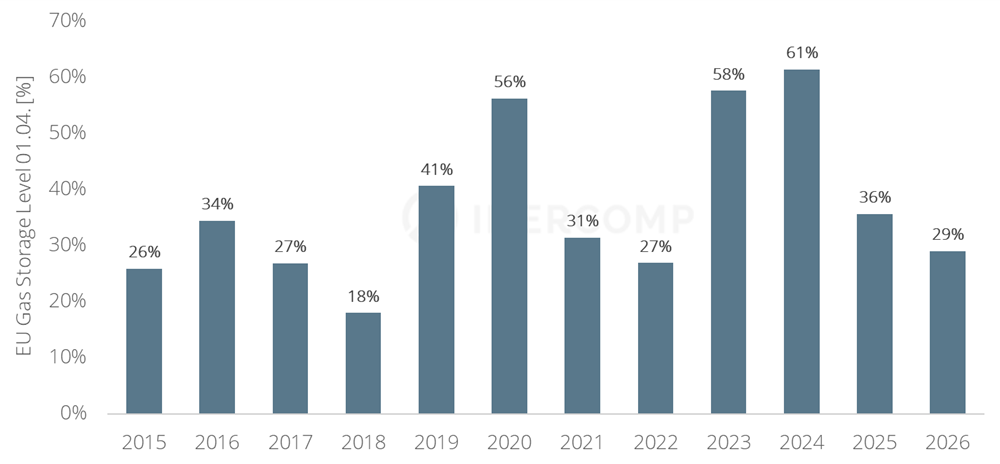
This puts European gas storage back at the center of attention. Winter 2025/26 was significantly colder than the two exceptionally mild previous winters. Europe entered the injection season on 1 April with only around 316 TWh in storage, or roughly 29% full. That is the lowest value since 2022. By comparison, storage levels in early April 2024 were still around 61%.

EU-Gasspeicherstände jeweils zum 1. April seit 2015; 2026 liegt mit 29 % deutlich unter den Vorjahren 2023 und 2024.

Chart 1: EU gas storage levels as of 1 April in each year since 2015.

So far, injections have developed in two phases. While Europe recorded solid injection rates in April, the pace slowed noticeably in May. By 17 May, a total of around 98 TWh had been injected. Storage levels currently stand at around 414 TWh, or approximately 37% full. One reason for the recent slowdown may have been the cooler temperatures that returned to parts of Europe, which pushed heating demand higher again in May.

Why the market remains under pressure

At the same time, summer-winter spreads remain clearly negative: the market is signaling that injecting gas into storage is economically unattractive. Even so, regulatory pressure to meet Europe’s storage targets on time is increasing.

How critical the situation could become next winter depends above all on how quickly storage can be refilled over the coming months. Based on historical injection rates since 2015, three scenarios emerge for the end of September:

  • Low case: average of the three weakest injection years since 2015

  • Base case: average of all years since 2015

  • High case: average of the three strongest injection years since 2015

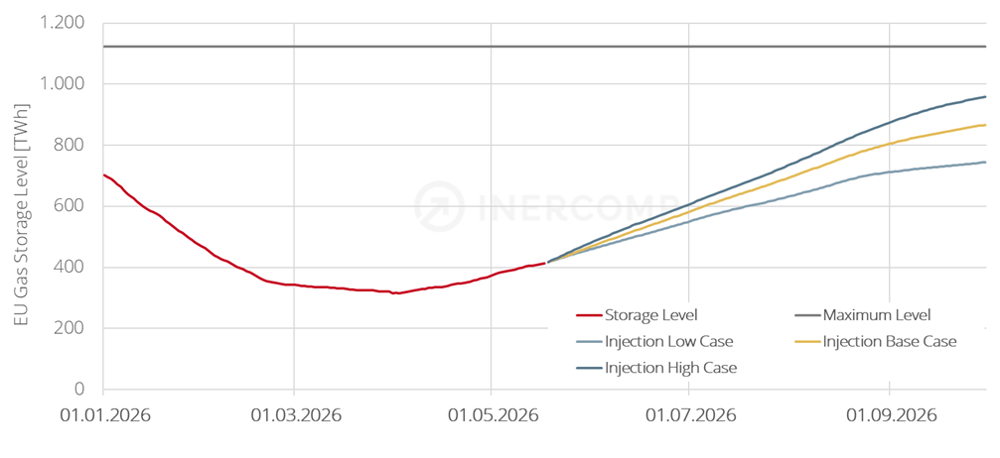
Under a strong scenario, storage levels would recover to around 960 TWh, or 85% full. Under the historical average, they would reach only around 870 TWh, or 77%, by the end of September. In a weak injection scenario, Europe would reach only around 744 TWh, or 66%.

Modellierte EU-Gasspeicherpfade bis 30. September 2026 mit Low-, Base- und High-Case für die Einspeicherung.

Chart 2: Modeled storage paths through 30 September 2026 (Low / Base / High).

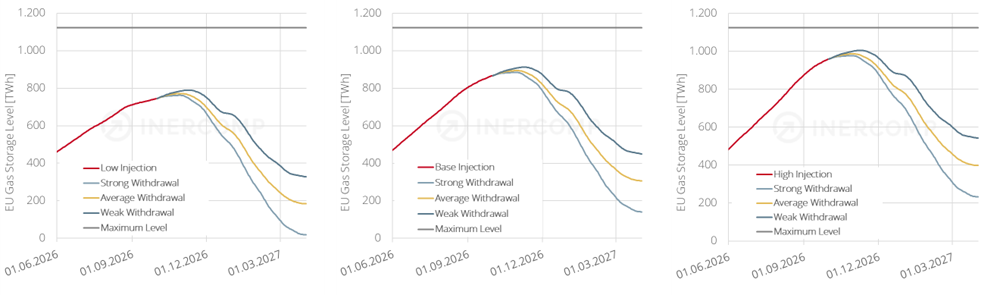
Even more critical than the fill level at the end of summer is the path through the winter. Combining the three injection scenarios with historical winter patterns shows the following: in the base case with average withdrawals, storage levels would still be around 307 TWh, or about 28%, by April 2027. A cold winter would reduce them to around 141 TWh, or about 13%. In the extreme case of weak summer refilling and a harsh winter, storage would be virtually empty on paper.

Szenarien für EU-Gasspeicher bis 1. April 2027 bei unterschiedlicher Sommerbefüllung und Winterausspeicherung.

Chart 3: Storage scenarios through 1 April 2027.

These scenarios therefore point less to an immediate supply problem and more to the fact that prices would need to rise sharply in winter in order to attract additional LNG volumes to Europe. If storage levels were to fall significantly, European hub prices would likely rise strongly long before storage actually approached zero. That very price signal would redirect additional LNG cargoes to Europe. Europe’s security of supply now depends far more on its willingness to pay on the global LNG spot market than it did just a few years ago.

The European gas crisis that has been ongoing since 2021 is probably closer to its end than it was two years ago. But recent developments show that Europe now depends heavily on stable global LNG flows and on the geopolitical developments connected to them. Contrary to earlier market expectations, winter 2026/27 could therefore once again become a winter with considerable price risk. A physical supply shortage nevertheless remains unlikely.

Conclusion

Security of supply for the winter is intact, and a physical shortage remains unlikely. The real risk is price: low storage levels, competing Asian LNG demand, and geopolitical uncertainty could drive European hub prices up significantly this winter.

For industrial gas consumers, this means that procurement-side price risk is currently being underestimated. Negative summer-winter spreads and regulatory pressure to fill storage create a difficult tension around gas storage. There will be more clarity only once the Strait of Hormuz reopens and once storage levels at the start of winter are known. A strategy that combines fixed-price procurement with spot exposure is currently preferable to a pure spot strategy.

SimonKoller_web


by Simon Koller, Senior Energy Expert at Inercomp  •  21.05.2026